
Religion - point of view from a non-religious person perspective (Me)
Religion may be defined as a cultural system of designated behaviors and practices, worldviews, texts, sanctified places, prophecies, ethics, or organizations, that relates humanity to supernatural, transcendental, or spiritual elements.
What would God make of religion?
- Adherents of religion often make the claim that their religion is the only way to God. Poor God has so many conflicting religions – each claiming to be the only way to salvation. But, which religion did God really create?
- God did not create the human religions, but, God did give man the opportunity to seek Him in a divine way. Do you agree?
- There is a few religions and all similar.... well I was
wrong, very wrong.
- You have been given the free will but you have to follow
the ten commandments?
- Why!? So you are not free to choose are you?
- How about the spirituality?
- Religion vs Spirituality - Religion is a path to God.
Spirituality is also a path to God. However, they have differences
in approach.
“The essence of
religion:
Fear God and obey
God.
The quintessence of
spirituality:
Love God and become
another God.”
After my research I still don't have my answer
but was a very funny journey and I've learn many things.
Many believes that:
-“There is a human religion and a
divine religion. The human religion is a baseless
self-aggrandisement. The human religion is a lifeless confidence. The
divine religion is a constant God-proclamation from the very depth of
the seeker’s heart. It is in the inmost recesses of his heart that
a seeker proclaims God’s Reality, God’s Divinity, God’s
Immortality. ”
The concept of "religion"
This concept was formed in the 16th and
17th centuries, despite the fact that ancient sacred texts like the
Bible, the Quran, and others did not have a word or even a concept of
religion in the original languages and neither did the people or the
cultures in which these sacred texts were written.
Known Ancient sacred texts books:
- Christianity (2.2 billion followers) - The Holy Bible (Old
Testament and New Testament)
- Islam (1.6 billion followers) - The Quran
- Hinduism (1 billion followers) - has many holy books, but
most popular is Shreemad Bhagavad Gita, Upanishads and Veda.
- Buddhism (376 million followers) - Tripitaka (Pali Canon)
- Sikhism (23 million followers) - Guru Granth Sahib
- Judaism (14 million followers) - The Hebrew Bible / Torah
(Old Testament)
- Bahá’í (7 million followers) - Kitáb-i-Aqdas
- Jainism (4.2 million followers) - Agam Sutras
- Shinto (4 million followers) - Kojiki
- Zeroastrianism (2.6 million followers) – Avesta
Which religions believe in God?
- Sikhs believe that members of other religions such as Islam, Hinduism and Christianity all worship the same God, and the names Allah, Rahim, Karim, Hari, Raam and Paarbrahm are frequently mentioned in the Sikh holy scriptures.
Do all religions believe in one God?
- The concept of ethical monotheism, which holds that morality stems from God alone and that its laws are unchanging, first occurred in Judaism, but is now a core tenet of most modern monotheistic religions, including Zoroastrianism, Christianity, Islam, Sikhism, and Bahá'í Faith.
Which religion does not believe in
God?
- Jainism believes the universe is eternal and has no need for a creator deity, however Tirthankaras are revered that can transcend space and time and have more power than the god Indra. Secular Buddhism does not advocate belief in gods. Early Buddhism was atheistic as Gautama Buddha's path involved no mention of gods.
Which religions believe in Jesus?
- Christianity teaches that Jesus is the Messiah (Christ) foretold in the Old Testament and the Son of God Incarnate. Christians believe that through his death and resurrection, humans can be reconciled to God and thereby are offered salvation and the promise of eternal life.
How many gods does Christianity
have?
- The doctrine of the Trinity can be summed up as: "The One God exists in Three Persons and One Substance, as God the Father, God the Son and God the Holy Spirit." Trinitarians, who form the large majority of Christians, hold it as a core tenet of their faith.
How many different gods are there?
- Originally Answered: How many gods are there in total? Since Hinduism is a religion with millions of gods and goddesses, the exact number is unknown. The exact approx. is 320,000,000 gods, plus the pantheons of famous mythologies which combined come close to 140, and the God of Abrahamic religions, the same one.
Who do the Jews believe in?
- The belief that Jesus is God, the Son of God, or a person of the Trinity, is incompatible with Jewish theology. Jews believe Jesus of Nazareth did not fulfill messianic prophecies that establish the criteria for the coming of the messiah.
What are the main beliefs of Islam?
- Muslims believe that Islam is the complete and universal version of a primordial faith that was revealed many times before through prophets including Adam, Abraham, Moses and Jesus. Muslims consider the Quran to be the unaltered and final revelation of God.
The earliest evidence of religious ideas dates back several hundred thousand years to the Middle and Lower Paleolithic periods. Archaeologists refer to apparent intentional burials of early Homo sapiens from as early as 300,000 years ago as evidence of religious ideas.
Other evidence of religious ideas include symbolic artifacts from Middle Stone Age sites in Africa. However, the interpretation of early paleolithic artifacts, with regard to how they relate to religious ideas, remains controversial.
Archeological evidence from more recent periods is less controversial. Scientists (generally interpret a number of artifacts from the Upper Paleolithic (50,000-13,000 BCE) as representing religious ideas. Examples of Upper Paleolithic remains associated with religious beliefs include the Zion man, the Venus figurines, cave paintings from Chauvet Cave and the elaborate ritual burial from Sungir.
In the 19th century researchers proposed various theories regarding the origin of religion, challenging earlier claims of a Christianity-like *urreligion.
*Urreligion is a notion of an "original"
or "oldest" form of religious tradition (ur-being
a Germanic prefix for "original, primitive, elder, primeval, or
proto-"). The term contrasts with organized religion, such as
the theocracies of the early urban cultures of the Ancient Near East
or current world religions. The term originates in German
Romanticism.
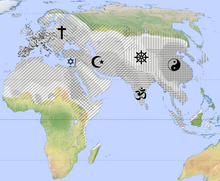
What religion was Europe before
Christianity?
- Bronze and Iron Age religion in Europe as elsewhere was predominantly polytheistic (Ancient Greek religion, Ancient Roman religion, Basque mythology, Finnish-paganism, Celtic polytheism, Germanic paganism, etc.). The Roman Empire officially adopted Christianity in AD 380.
What is the oldest religion?
The oldest record of the complete
biblical texts (the Codex Sinaiticus) survives in a Greek translation
called the Septuagint, dating to the 4th century CE. Theodosius I
declared Nicene Christianity the state religion of the Roman Empire.
How many religions are there in the
world?
- There are roughly 4,200 religions in the world.
- The major world religions are Hinduism, Buddhism, Islam, Christianity.
But
Who the hell started religion and which is the true one?
(there is for all tastes and plus)
Medieval to Early Modern (500–1800 AD)
| Name | Religious tradition founded | Ethnicity | Life of founder |
| Mazdak | Mazdakism | Central Iranian/Airya | died c. 526 |
| Bodhidharma | Zen | Indian | 504s - 560s |
| Muhammad | Islam | Arabian | 570 - 632 |
| Songtsen Gampo | Tibetan Buddhism | Tibetan | 7th century |
| En no Gyōja | Shugendō | Japanese | late 7th century |
| Huineng | East Asian Zen Buddhism | Chinese (Tang dynasty) | 638–713 |
| Padmasambhava | Nyingma | Indian | 8th century |
| Han Yu | Neo-Confucianism | Chinese | 8th or 9th century |
| Saichō | Tendai (descended from Tiantai) | Japanese | 767–822 |
| Kūkai | Shingon Buddhism | Japanese | 774–835 |
| Adi Shankara | Advaita Vedanta | Indian | 788-820 |
| Ibn Nusayr | Nusayrism | Persian | late 9th century |
| Ramanuja | Vishishtadvaita | Indian | 1017-1137 |
| Hamza ibn ‘Alī ibn Aḥmad | Druze | Persian | 11th century |
| Sheikh Adi ibn Musafir | Yazidism | Yazidi | 12th century |
| Basava | Lingayatism | Indian | 12th century |
| Hōnen | Jōdo-shū (descended from Pure Land Buddhism) | Japanese | 1131–1212 |
| Eisai | Rinzai Zen (descended from the Linji school) | Japanese | 1141–1215 |
| Shinran | Jōdo Shinshū (descended from Jōdo-shū) | Japanese | 1173–1263 |
| Dōgen | Sōtō Zen (descended from the Caodong school) | Japanese | 1200–1253 |
| Haji Bektash Veli | Bektashi Order of Sufism | Turkish (Ottoman) or Persian | 1209–1271 |
| Nichiren | Nichiren Buddhism | Japanese | 1222–1282 |
| Madhvacharya | Dvaita | Tuluva (Indian) | 1238–1317 |
| Sant Mat | Bhakti movement | Numerous Hindi groups | 13th to 15th centuries |
| John Wycliffe | Lollardy | British (English) | 1320s–1384 |
| Nāimī - Fażlu l-Lāh Astar-Ābādī | Hurufism | Iranian | 14th century |
| Mahmoud Pasikhani | Nuqṭawism | Iranian (Persian) | late 14th century |
| Jan Hus | Hussitism | Frankish (Czech) | 1372–1415 |
| Tlacaelel | Cult of Huitzilopochtli | Aztec | 1397–1487 |
| Ramananda | Vaishnavism | Indian | 15th century |
| Pachacuti | Cult of Inti | Incan | 1418–1472 |
| Sankardev | Ekasarana Dharma | Assamese (Indian) | 1449–1568 |
| Guru Nanak | Sikhism | Punjabi (Pakistani) | 1469–1539 |
| Sri Chand | Udasi | Punjabi (Pakistani) | 1494–1629 |
| Vallabha Acharya | Shuddhadvaita | Indian | 1479–1531 |
| Martin Luther | Lutheranism and Protestantism | Frankish (Saxon) | 1483–1546 |
| Chaitanya Mahaprabhu | Gaudiya Vaishnavism, Achintya Bheda Abheda | Bengali (Indian) | 1486–1534 |
| Thomas Cranmer | Anglicanism (Church of England) | British (English) | 1489–1556 |
| Menno Simons | Mennonite | Dutch | 1496–1561 |
| Conrad Grebel | Swiss Brethren, Anabaptists | Swiss | 1498–1526 |
| Jacob Hutter | Hutterite | Tyrolean (Bavarian) | 1500–1536 |
| Sultan Sahak | Yarsanism | Kurdish | early 15th century |
| John Calvin | Calvinism | French | 1509–1564 |
| Michael Servetus | Unitarianism | Aragonese | 1511?–1553 |
| John Knox | Presbyterianism | Scottish | 1510–1572 |
| Akbar | Din-i Ilahi | Indian (Mughal) | 1542–1605 |
| Jacobus Arminius | Arminianism | Dutch | 1560–1609 |
| John Smyth | Baptists | English | 1570–1612 |
| Avvakum | Old Believers of Russian Orthodox Church | Russian | 1620–1682 |
| George Fox | Quakers | English | 1624–1691 |
| Philipp Spener | Pietism | Alsatian (German) | 1635–1705 |
| Jakob Ammann | Amish | Swiss | 1656–1730 |
| Emanuel Swedenborg | The New Church | Swedish | 1688-1772 |
| Yisroel ben Eliezer "Baal Shem Tov" | Hasidic Judaism | Polish (Ukrainian) | 1698–1760 |
| John Wesley,Charles Wesley, George Whitefield | Methodism | English | 1703–1791 |
| Ann Lee | Shakers | English | 1736–1784 |
Comments
Post a Comment